 art and writing creative exchange reviews word
publish write a review create a group links contact
bhag.net online magazine of visual and conceptual exchange


bhag interviews
Coconut: Interview with John and Elizabeth Clay
conducted by Mark Katzman
reprinted from Coconut, Spaceboy Books, 2025
introduction
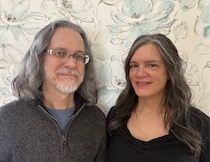
John and Elizabeth Clay's literary novel Coconut was published by Spaceboy Books in 2025. They have been writing, editing, and making art together since 2007.
John was born in Indiana and spent formative years of his childhood in Africa and South America and his adult years in Boston and New York City before joining Elizabeth in Minnesota. He holds a bachelors degree in anthropology and a masters degree in music composition.
Elizabeth, born in Minnesota and adopted into a loving family, found and met many of her birth relatives through years of exhaustive genealogical research. She spent formative years of her young adulthood traveling extensively in Europe. She holds a bachelors degree in psychology and a masters degree in horticulture.
interview
MARK: What led you to write this book?
ELIZABETH: Writing a book is something I always thought I might do. After sharing the story of my search for my birth parents, friends would often ask me if I was writing a book. I think that helped me make the leap, to begin writing the story. Another event that changed everything was when I met John and learned he was a writer, and I asked him if he would like to write the book with me. Having another person help with what seemed like an impossible endeavor made it easier to begin.
JOHN: As child I had always wanted to write. And in fact I have spent my adult life writing. Poetry, journaling, correspondence, publishing in online and print media. But the book had to wait for the two of us to join forces. I had never tackled anything of this length before. Elizabeth’s determination to write a book, a whole book, inspired me to believe that, yes, this is actually possible.
Mark: How do two people write a book together?
ELIZABETH: Writing a book with another person can be really rewarding. Putting your ideas together, all of that creativity makes for some amazing stories. Having another person to share ideas with, work through challenges with, and edit with, and edit some more is truly invaluable. Being open to each other’s ideas and being able to set your own ideas aside sometimes so that the other person’s ideas can blossom is really important to allowing the work to reach its potential. Working with another person year after year and then finally coming out the other side with a completed quality piece of work is a true accomplishment, one that brings you closer together.
JOHN: On one hand, it was easier because we split the workload. While one of us was crafting rough drafts into finished narrative, the other was rough-drafting new material. And when we edited, one of us would catch issues that the other missed, and if one of us was struggling to come up with a fix, usually the other had an idea. On the other hand, it was harder because we had two drivers at the wheel. Sometimes we sorted out differences quickly, other times it was a long and painful negotiation. The fact is, this book is better because we created it together.
Mark: The novel has an impressive scope. How did you decide on the structure of the book?
ELIZABETH: I’ve always had a real gut sense about what this book had to accomplish, both with the overall structure and with the way in which the story would unfold. Once John became co-author, the book became so much more. He’s so imaginative and when we put our ideas together, the story would evolve in such interesting ways. As our ideas blossomed, relying on that gut sense helped to keep us on course.
JOHN: At a high level, the book is structured as a family tree. We go from grandparents to parents to child. On a smaller level, we do what every writer does, we assemble scenes that represent a life lived. You can’t tell every story of a life, but you can tell the whole life story by assembling the right moments.
Mark: Adoption figures strongly in the stories of Mary and Catherine. Can you talk a little about that?
ELIZABETH: Catherine and Mary are both adopted and as they move through life, they each struggle with their identity. They both have this sense of being uprooted, not knowing who or where they came from, and they each deal with it in different ways. Mary creates her identity as she moves through life. Catherine has to go back before she can move forward. The story shows that the path to finding their place in the world can be a winding one.
JOHN: A big part of the novel is the struggle of the characters to live true to themselves. It’s a struggle we all face as we venture out into the world hoping to find a career, like-minded friends, lovers. I’ve learned that knowing where we came from, something most of us know and take for granted, really helps us understand our true selves. It grounds us in ways we’re hardly aware of, ways that matter.
Mark: Has writing this book changed you, made you think differently about life?
ELIZABETH: Writing this book has realized my life as an artist in a new way. It was, aside from becoming a mother, the longest project I have ever taken on, even longer than the fourteen-year quest to find my birth family. Writing is all-consuming. All other creative endeavors fell to the wayside. I’ve come to know the art process at a deeper level, that no matter the medium, the process reveals itself along the way, takes on a life of its own, becomes a partner to interact with.
JOHN: Something important about writing this book is that in trying to understand the characters and what motivates them to do what they do, I’ve had to look deeper into my own life and what motives me. It’s like method acting, finding the feeling in myself so that I could then give it to a character. I think it has helped me to understand myself better.
more about Coconut A Novel at
Return to bhag interviews